

05 Mar Panoptix Pro IOL
The Panoptix Pro IOL (Intraocular Lens) gives a more full range of vision to most patients after cataract surgery. It is the most commonly used multiple focus lens in the world.
Cataract surgery involves the removal of your blurry cataract lens and then replacing it with an IOL. There are several different types of IOLs you can choose at that time depending on what you want to be able to see without glasses. There are three important distances for most of us, distance, intermediate (computer), and near (books). A single vision IOL provides focus at just one of those distances without glasses. For example, if you select distance vision without glasses, you would need glasses for intermediate and near vision tasks.
A multiple focus lens gives vision without glasses at more than one distance. Bifocal and trifocal multiple focus lens options are available. The bifocal EDOF lenses like the Vivity IOL blend light with an emphasis on two focal points. (distance and intermediate vision). They give vision for distance and for intermediate vision without glasses, but often readers are still needed for paper book reading.
Panoptix Pro IOL
The Panoptix Pro IOL splits the light into three focal points, distance, intermediate, AND near. In Europe there are other trifocals available like the at-Lisa and the Fine vision. The AT-Lisa lens and the Fine Vision lenses use a sequential diffractive pattern to split light. This means that the near vision distance, mathematically, will always be exactly half the intermediate distance. These lenses therefore have intermediate at approximately 80 cm (31.5 Inches) and near at approximately 40 cm (15.75 Inches). Alcon conducted studies with patients and determined that most patients preferred a closer intermediate distance of 60 cm (23.62 inches) rather than the 80 cm used by most other companies.
To achieve this, they started with a quadra-focal design which would have had 4 focal points: distance, 120 cm, 60 cm, and 40 cm focal points, but they directed all of the light from the 120 cm peak back to distance. This created a trifocal lens with distance, 60 cm, and 40 cm defocus peaks. This also makes the PanOptix Pro a distance dominant lens by directing a greater amount of the light to enhance distance vision. Achieving this is part of the reason the Panoptix Pro is the most commonly implanted trifocal IOL in the world.
PanOptix IOL Defocus Curve
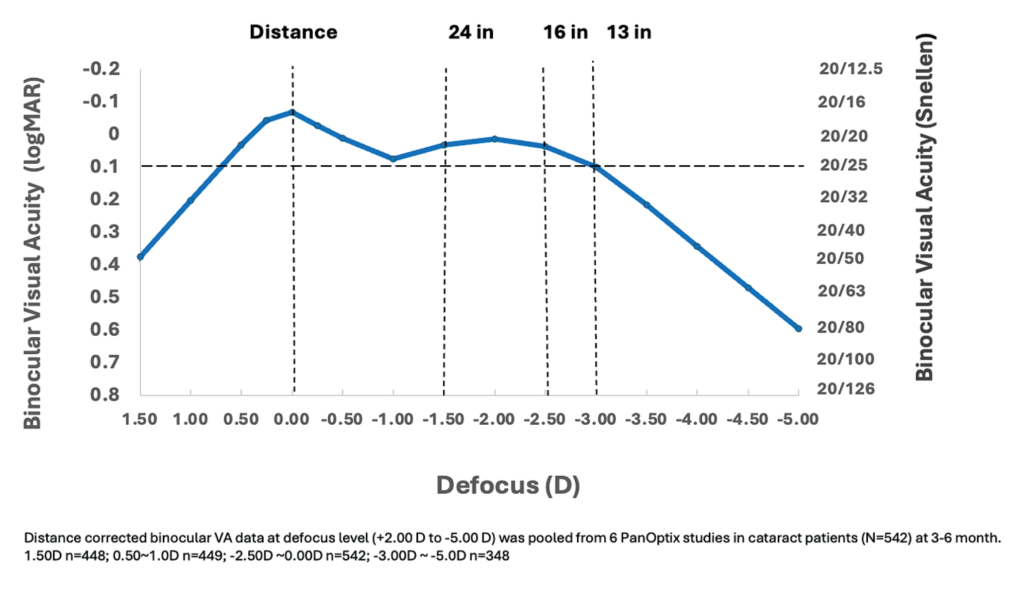
Defocus curves demonstrate the range of vision created by an IOL. The data from the FDA trial show that on average, corrected distance vision with the Panoptix is around 20/16 (better than 20/20). Intermediate vision at 24 inches is approximately 20/20 and reading vision at 16 inches is around 20/20 on average.
Disadvantages of the Panoptix Pro IOL
A standard IOL focuses all of the light that enters the eye to one point of focus. If the eye is focued on a distance object. All the light that enters the eye is focused on that distance object. If reading glasses are put on to focus on a near object, all the light is focued on the near object and non is focued on a more distance target. This give the maximun amount of contrast and clarity to vision. Multifocal IOLs spllit the light so part of the night focuses on a distance object and part of the light focuses on a near target. This is fantastic as it allows patients to see both near and far objects at the same time! This also means that the far image only has part of the light and the near image has part of the light. The physics of this lead to the quirks of multiple focus lenses which are: 1. Halos around headlights at night for some patients, 2. Good distance vision (but not quite as good as a monofocal IOL that doesn’t split light), 3. Shadow around letters when reading for a small percent of patients. If you want to learn more about Panoptix Pro dissadvantages click the embeded link.
Who should choose a Panoptix Pro IOL?
I recommend a monofocal IOL like the light adjustable lens to patients that want their ideal distance vision and don’t mind wearing readers for anything up close.
I recommend the Panotix Pro IOL to patients if they meet the following criterion: 1. Reasonable cornea and tear film quality, 2. Strong desire for glasses independence, 3. Cant do monovision, 3. Want to see both electronics (phone/computer) and to read paper books, 4. Don’t drive much at night.
I recommend the Vivity IOL for the following patients: 1. Reasonable cornea and tear film quality, 2. Strong desire for less dependance on glasses, 3. Most of the near content they consume is electronic (computer, phone, kindle, etc.), 4. Willing to wear reading glasses for the rare occations they need to read a paper book or look at a pill bottle etc. 4. Want to avoid night halos do to above average night driving needs.
I recommend the Apthera IOL if patients have highly abnormal corneas.
I recommend the the light adjustable lens if patients want monovision (one eye for far and the other set for near) if they have already proven they can handle monovision with previous contact lens use.
I have helped tens of thousands of patients make these choices over the past thirty years. For example, I put the predecessor to the Panoptix Pro IOL (the ReStor IOL) in my father becuase he was a volleyball ref and didn’t want people making fun of him for pulling out glasses to check the score card. I put Light Adjustable Lenses in my wife who wanted to improve night driving and had eyes too dry for a multiple focus IOL.
Likely questions will remain about which IOL is ideal for you. Choose a surgeon that specializes in these advanced technology lenses and make an appointment to spend time discussing your best future once they examine your eyes and get to know you and your desires.
If you would like to learn more or to schedule an appointment, please call us 970.221.2222.
We look forward to meeting you,
Gary Foster, M.D.
Board Certified Ophthalmologist
Cataract and Laser Vision Specialist
Fort Collins
Sorry, the comment form is closed at this time.